Valley Foundation Repair offers and manages residential and commercial foundation repair in North Las Vegas and nearby areas, fulfilled by licensed and insured contractors. Start with the question that affects your decision. The explanations separate observations from diagnosis, then compare the work a proposal may include.
Organize reports, repair proposals, unresolved structural questions and completion records so a foundation concern can be evaluated before a property transaction.
Compare foundation proposals by diagnosis, building element, support method, engineering, permits, installation records and restoration before deciding what the totals mean.
Understand the different roles of structural engineering, geotechnical investigation and a contractor repair assessment before choosing the next step for foundation concerns.
Understand how project scope, parcel jurisdiction, design documents, contractor licensing and required inspections determine the permit path for foundation repairs.
Plan foundation underpinning around the published $1,000–$3,300 per installed pier range, with scope factors, permit responsibilities and an illustrative pier budget.
Compare helical and push piers by load transfer, installation reaction, soil conditions, access and the records needed to evaluate a foundation support proposal.
Plan occupancy during foundation work around structural condition, excavation, access, utilities and the agreed construction sequence, without assuming every room remains usable.
Plan post-tensioned slab repairs around the structural system, tendon locations, engineered access, ground conditions and the inspection requirements of the project jurisdiction.
Separate downward settlement from upward heave before selecting lifting, underpinning or ground treatment, with attention to measurements and water-related mechanisms.
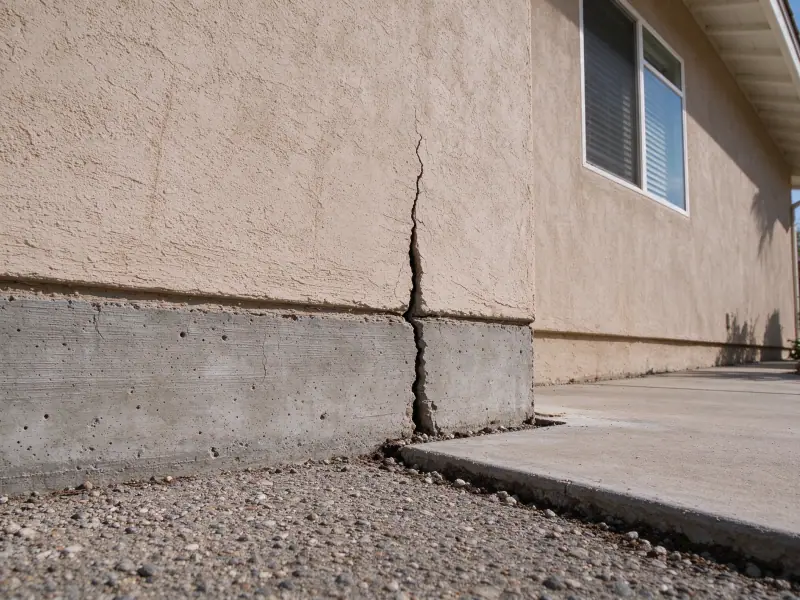
Read foundation warning signs in context: changing cracks, uneven floors, openings and exterior separation, with a practical assessment and documentation plan.
Learn why cracks follow masonry joints, what displacement and wall construction change, and when foundation assessment is needed before masonry repair.
Understand the purpose, movement and material questions behind structural and nonstructural cracks before choosing injection, stabilization or finish repairs.
Understand when foundation support, slab lifting or void treatment addresses the affected building element, and why uneven floors do not identify the repair by themselves.
Understand foundation types, settlement and heave, local ground conditions, assessment, support methods, replacement decisions and the records a repair should leave.
Consider floor differences, misaligned openings, drywall cracks and exterior separation together, with clear limits on what visible symptoms can prove.
Understand leaks, runoff, soil moisture and foundation support as connected but separate questions, without assuming every wet area caused a structural problem.