
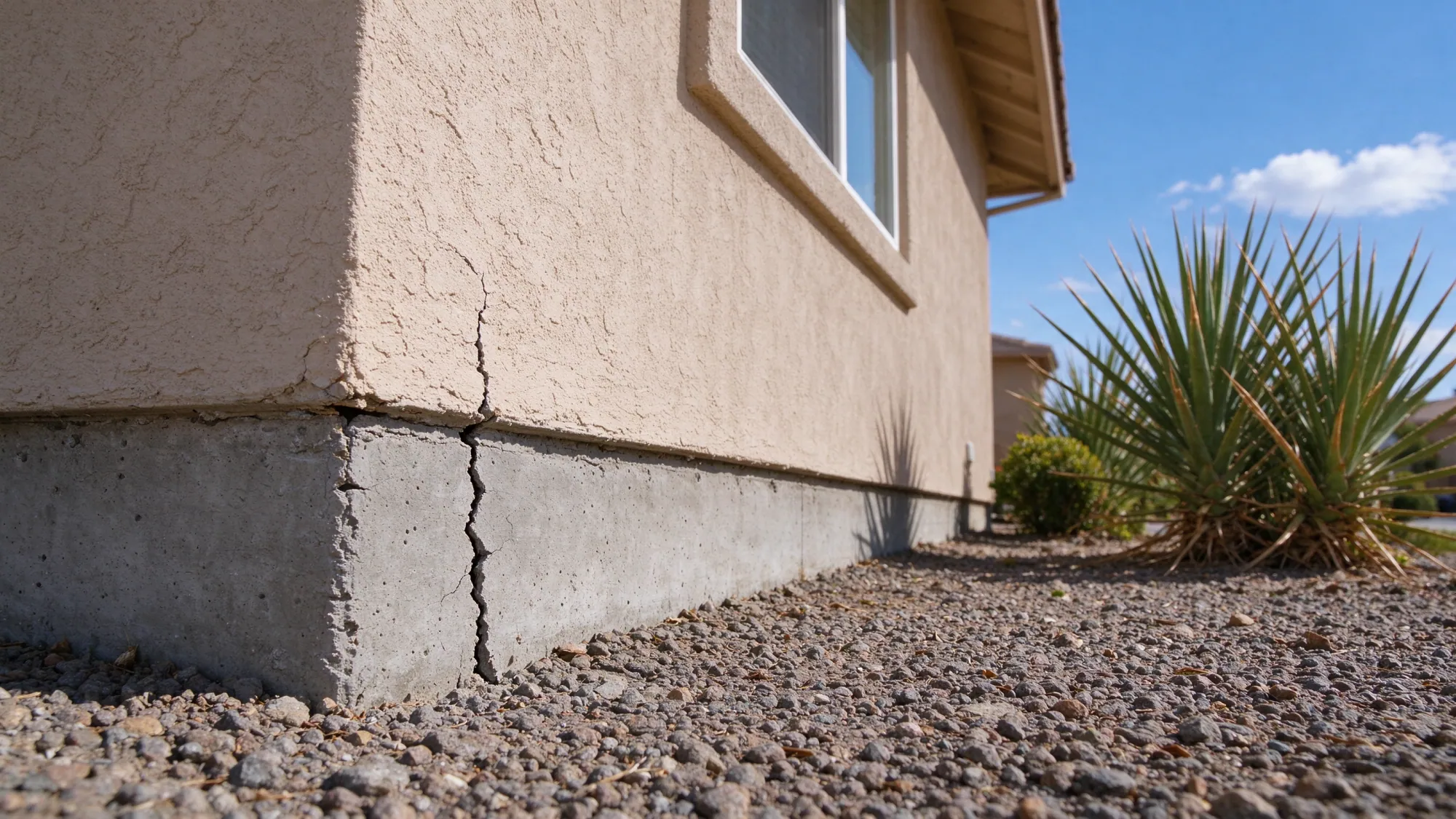
A suitable hairline foundation crack injection in the Las Vegas area has a published planning range of $450–$1,800 per repair scope; the range does not state a crack count or price structural stabilization. Valley Foundation Repair offers and manages residential and commercial foundation crack repair, fulfilled by licensed and insured contractors.
The word “crack” describes an observation, not a standard package. A surface finish patch, injection into suitable foundation material and support work address different things. Establish which element is cracked and why the proposed repair fits before comparing a low injection number with a structural construction price.
What does the injection range actually cover?
The budget band concerns injection of a suitable hairline foundation crack. Suitability depends on the material, condition and purpose of the repair. A proposal should state where the repair is located, what preparation is needed and whether the objective is sealing, a specified material repair or something else.
The published unit is a repair scope with no stated crack count. It is not a per-foot rate, a whole-house allowance or a price for each line visible in a photograph. Do not multiply it by a guessed quantity. Ask the contractor to define the number and extent of repairs included in the actual proposal.
Movement changes the question. An injection does not automatically restore lost bearing or stop a slab or footing from moving. The structural versus nonstructural crack guide explains why crack width or appearance alone cannot select the entire repair scope.
Which findings change the work being priced?
| Factor | What to establish | Scope implication |
|---|---|---|
| Material | Foundation concrete, masonry or finish layer? | Preparation and suitable repair method differ |
| Movement | Is the pattern changing, and what explains it? | Active support movement may require separate work |
| Access | Is the repair exposed or behind finishes? | Openings and restoration must be identified |
| Crack condition | Contamination, previous filler or damaged edges? | Preparation and repair suitability may change |
| Structural role | Is a load-carrying connection affected? | Professional design may be required |
| Adjacent symptoms | Uneven floors, separations or recurring damage? | A broader assessment may be needed |
A newly uncovered line may be an old condition. A recently patched line may hide part of the history. Gather photographs and previous repair records so the assessment can distinguish what is known from an assumption based on the present finish.
What’s inside a North Las Vegas foundation crack repair price
Most of a North Las Vegas crack repair price is concrete labor, material and access to the crack, with finish restoration on top. Cement masons and concrete finishers in the Las Vegas metro earn about 7% more than the national mean, so local labor sits a little above a national budgeting figure.
| Part of the price | What sets it | Local figure |
|---|---|---|
| Concrete and injection labor | Cement masons and concrete finishers handle crack, patch and slab work | Las Vegas metro mean $30.89 an hour, about 7% above the $28.87 national mean (BLS OEWS) |
| Excavation and handling labor | Construction laborers dig access pits, move material and clean up | Metro mean $25.52 an hour, about 2% above the $25.02 national mean (BLS OEWS) |
| Permit and plan review | North Las Vegas Municipal Code 15.72.230 sets the building permit fee from the project valuation (Table 3-A: $143 at $5,000, $169 at $10,000, $249 at $20,000, $408 at $50,000). When plans must be submitted, building plan review adds 65% of that permit fee and zoning plan review adds 10% | About $250 to $714 in combined permit and plan review fees for valuations of $5,000 to $50,000. The city sets the valuation and other city fees may apply, so confirm with the City of North Las Vegas |
| Finish restoration | Paint, drywall, flooring or exterior coating over the repaired area | No public figure; check whether the proposal includes it |
A wage is not a billing rate. The hourly rate billed for this work also carries insurance, licensing, vehicles, equipment and overhead. No public source gives the labor hours for a foundation repair, so these wages explain the published ranges instead of producing a new total. Whether a permit applies depends on the authority and the scope, so the plan check line only matters when the repair needs one.
Separate a finish repair from foundation material repair
Drywall, stucco and tile can crack for more than one reason. Their repair prices do not establish the cost of work within the foundation. Equally, a completed foundation material repair does not automatically include matching paint, tile replacement or other finishes disturbed by access.
Ask the proposal to identify the affected element and the final surface it leaves. A description such as “crack repaired” is too broad to compare preparation, material, access and restoration. If a surface-only repair is proposed, ask what evidence supports leaving the underlying condition unchanged.
For a recurring drywall line, read why cracks can return after patching. The next useful decision may be investigation, rather than purchasing a larger finish repair that still does not establish whether the foundation is involved.
What if the assessment identifies support movement?
A structural support repair uses a different planning unit. The published structural slab-foundation band is $5,200–$18,500 per project, while underpinning is $1,000–$3,300 per installed pier. These figures do not convert the injection band into a combined standard package. The design determines whether support work belongs in the scope at all.
A pier count cannot be derived from the number or length of cracks. Loads, foundation condition, attachment and ground support control that decision. Upward movement also requires a different investigation from simply assuming the cracked area settled. The settlement and heave comparison helps frame that question.
If deterioration has affected concrete or reinforcing, the material repair may likewise fall outside a suitable hairline injection. The written recommendation should explain which part of the load path is damaged and what a proposed support system or concrete repair will leave untouched.
Define the next step for your property.
Share the property location, what you have noticed and any existing reports. Start with the concern so the assessment can be defined.
(725) 999-4951Permit and inspection charges need address-specific confirmation
| Item | When to clarify it | What the estimate should say |
|---|---|---|
| Permit | Before agreeing to the proposed repair scope | Which authority and whether a permit is required |
| Plan review | Where the scope needs design review | Who supplies the documents and pays the charge |
| Required inspection | Before work conceals a repair needing observation | Who arranges and documents the inspection |
| Additional review | If the agreed design changes | How a revised scope and charge are approved |
A suitable material repair and a wider structural project may follow different approval requirements. Confirm those requirements with the actual permit authority instead of assuming all crack work is exempt or all crack work has the same fee. No numeric permit allowance is invented here.
Incentives and insurance are separate from the repair price
| Possible contribution | Verified treatment for this scope |
|---|---|
| Foundation crack repair rebate | None verified; no deduction included |
| Participating-contractor incentive | None verified; no eligibility claim made |
| Insurance reimbursement | Policy and cause-specific; no payment assumed |
An insurer’s answer depends on the actual policy and facts of the loss. A contractor’s injection recommendation does not establish coverage. Keep dated photographs, reports and the scope of any earlier repairs, then ask what documentation the insurer requires if a claim is being considered.
Illustrative budget for a suitable injection scope
This example assumes an assessment supports hairline injection, without assuming a crack count. The planning line is $450–$1,800 for that repair scope. The actual proposal must define its extent. There is no basis here to add a second identical charge for every visible line or to multiply by wall length.
| Illustrative line | Budget treatment |
|---|---|
| Suitable hairline injection scope | $450–$1,800 |
| Access through finishes | Confirm included work or obtain a separate price |
| Independent assessment or design | Confirm whether required and separately priced |
| Permits and required inspections | Confirm actual responsibilities and charges |
| Finish restoration | Confirm the surfaces and finish standard included |
| Complete project total | Not established until the scope is defined |
If investigation identifies continued structural movement, this illustration no longer describes the whole problem. The support recommendation and any remaining crack repair should be compared as explicit tasks, with overlapping inclusions identified before numbers are added.
Ask for a result you can recognize
A useful proposal states the repair purpose, material, preparation and work limits. It explains whether movement remains under investigation and what completion records are included. For foundation crack repair, the right next step is the one that addresses the condition rather than conceals its evidence.
Request an estimate with the property location, photographs and previous repair history. That gives the assessment a clearer starting point than choosing a material from a crack photograph or treating a budgeting band as a construction diagnosis.