
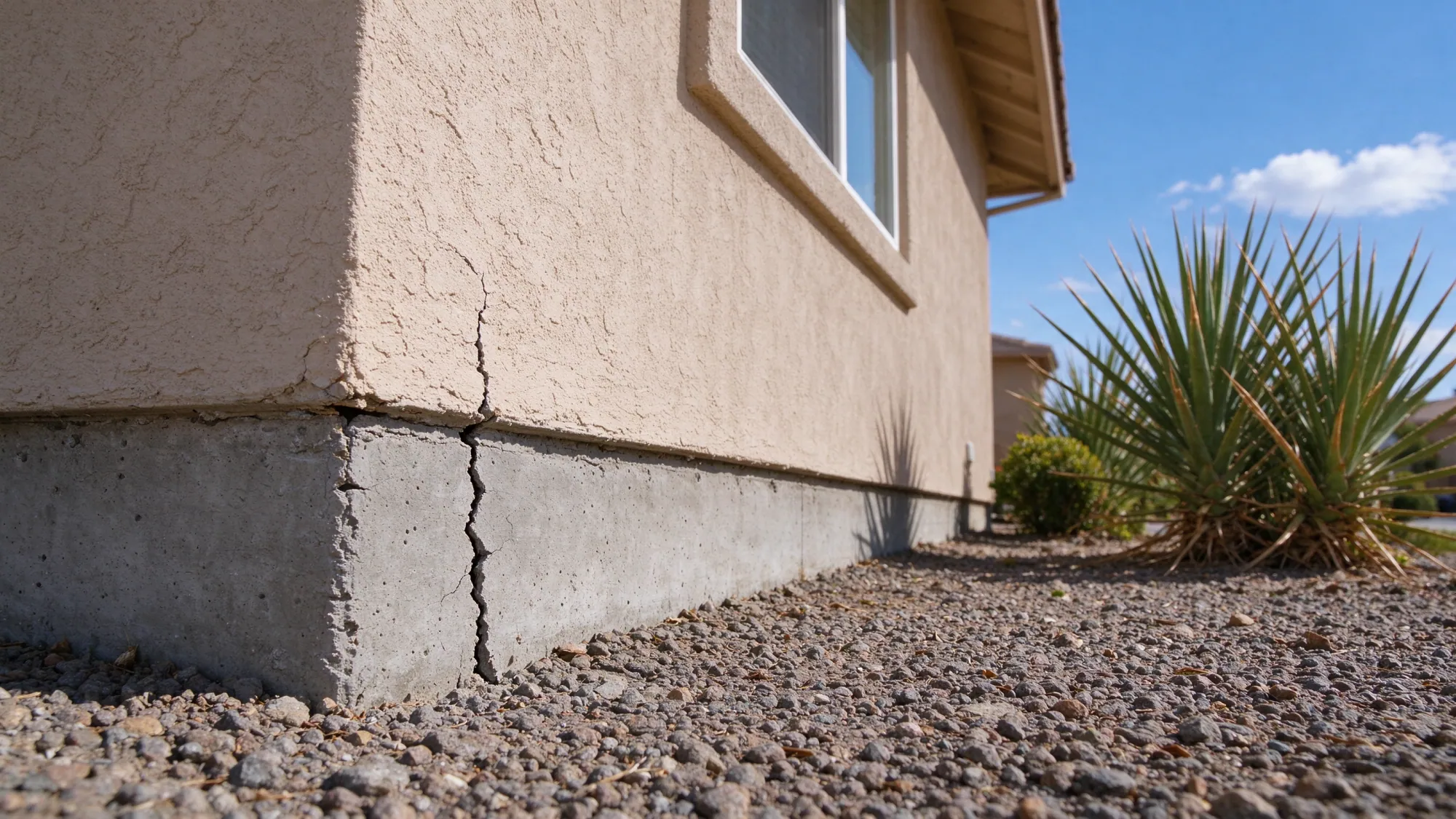
A drywall crack can return because the finish repair did not accommodate the movement, because the joint or framing continues to move, or because movement elsewhere in the building remains unresolved. Recurrence is a reason to investigate the pattern. It is not proof that the foundation is settling.
Valley Foundation Repair offers and manages residential and commercial foundation repair in North Las Vegas and nearby areas, fulfilled by licensed and insured contractors. We consider recurring finish cracks alongside the building’s other symptoms and records before defining whether foundation assessment is needed.
What does a repeated patch actually show?
A returned crack shows that the repaired location has separated or strained again. It does not identify the force responsible. The repair itself may be relevant: a surface-only treatment can leave a moving joint beneath it, and a crack may reappear at the edge of a stiff patch rather than along its earlier line.
Look at the relationship to the drywall construction. A line following a board joint raises questions about that joint and its attachment. A diagonal crack near an opening raises questions about how the surrounding assembly is moving. Those observations guide an assessment, but neither pattern automatically identifies a foundation defect.
The history of the repair is useful evidence. Keep the date, photographs and any description of what was done. An invoice saying only “patch and paint” leaves different questions unanswered from a detailed repair record. If the previous condition is unknown, be clear about that instead of guessing how long the crack has existed.
Why can finish movement and foundation movement look similar?
Drywall is attached to the building above the foundation. Movement within the framing or at its connections can affect the finish directly, while foundation movement can also transmit distortion upward through that assembly. The visible crack can therefore sit some distance from the element that changed.
Temperature and moisture changes within building materials may affect joints and openings. Alterations, attachment details and local damage can also matter. That range of possibilities is why a photograph of a ceiling or wall line cannot establish the ground condition below the building or justify a pier layout by itself.
A useful review asks whether other evidence fits the proposed cause. Has a nearby opening changed alignment? Is there a related floor difference? Does exterior separation occur in the same part of the building? A pattern across materials deserves investigation, while a single finish defect still needs to be understood in its own construction context.
Which observations should you gather from the room?
Photograph the wall from far enough away to show the opening, ceiling or corner that locates the crack. Add a closer view of the line and patch boundary. Note the date and whether the symptom is newly discovered or known to have changed. Do not describe discovery as recent formation unless the earlier condition is documented.
Record how doors and windows operate without forcing them. Note a change rather than trying to correct it before the condition is assessed. A loose hinge or finish problem can affect operation independently, so keep the observation separate from a conclusion about the foundation.
If the floor feels different, describe where and what changed. An informal reading cannot establish original elevations or whether a separate slab has moved relative to the footings. The uneven floors and sticking doors guide explains what a coordinated survey and opening review can add.
Define the next step for your property.
Share the property location, what you have noticed and any existing reports. Start with the concern so the assessment can be defined.
(725) 999-4951What can previous renovation work change?
A renovation can reveal damage that was previously hidden. Removing wallpaper, cabinets or flooring may make an old condition visible for the first time. Conversely, a newly installed finish may respond to the existing building in a different way. Timing helps frame questions but does not prove that the renovation caused the crack.
Structural alterations need a separate record. A removed wall, an addition or new equipment can change the loads or connections within a building. Where those changes are relevant, the responsible designer should evaluate them. Treating every recurring crack as a soil problem could overlook a structural issue above the ground.
The same care applies to plumbing or drainage work near the property. A known leak or changed water route may belong in the investigation, but coincidence is not causation. Ask how the available observations connect the water history to the affected support before accepting a moisture-based repair recommendation.
When is it sensible to patch again?
Another finish repair can make sense after the condition and repair objective have been established. A suitable joint repair is different from simply covering the visible line, and the finish contractor should understand any movement limits relevant to that work. Patching before assessment can conceal the pattern without answering the reason for its return.
If a structural repair is needed, its completion does not guarantee that drywall will recover by itself. Stabilization changes support; it may leave old finish cracks, door adjustments or paint work as separate restoration tasks. Define who carries out that work and which surfaces are included in the agreement.
A foundation crack repair scope concerns the foundation material, not an automatic drywall repair package. Be precise about which element is being repaired. The location of the visible symptom and the location of the necessary work may differ, and a proposal should make that relationship understandable.
What does a useful foundation review involve?
The initial discussion considers what changed, when it was noticed and which records exist. Visible symptoms and access are reviewed before defining whether measurements, independent structural evaluation or geotechnical investigation are needed. A repair estimate should not silently take the place of an independent professional opinion when that is the question the owner needs answered.
If a floor elevation survey is appropriate, ask what reference it uses and what it can establish. One survey can document relative levels but cannot by itself prove continuing movement. Repeated observations may be useful when collected consistently and interpreted within the assessment’s scope.
For a commercial property, identify who controls access to affected walls and adjacent tenant areas. A cosmetic line in a public room can lead to different assessment logistics from one in a vacant house. The building’s use should shape the access plan without changing the evidence needed to understand the cause.
What should the next proposal explain?
A useful proposal identifies the problem it is intended to address, the work limits and any remaining uncertainty. If foundation work is proposed, ask why that method fits the findings and what it will leave unchanged. If the issue remains within the finish system, the scope should be equally clear about its purpose.
Compare the diagnosis and the construction scope as separate parts of the decision. Neither the most extensive repair nor the smallest patch is automatically the sensible choice. The appropriate work is the work supported by the assessment, with access, permits where required and restoration responsibilities defined.
Start with a foundation assessment if the returning line is part of a wider unexplained change. Bring the repair history and context photographs. Establishing the cause before another cover-up preserves the information needed to choose a repair that addresses the actual condition.